I ran into this phrase in a Claude Code session. We were planning a feature with genuinely high cognitive complexity, and at one point Claude said “my a-fortiori reasoning was wrong” — and it bothered me, because I couldn’t immediately say what had actually been claimed. “A fortiori” is one of those phrases you deploy by feel — it sounds like the conclusion is now beyond dispute. So I went back and made the structure precise, and the precise version turns out to be a single, familiar property: monotonicity. A fortiori is monotonicity reasoning wearing a Latin name.
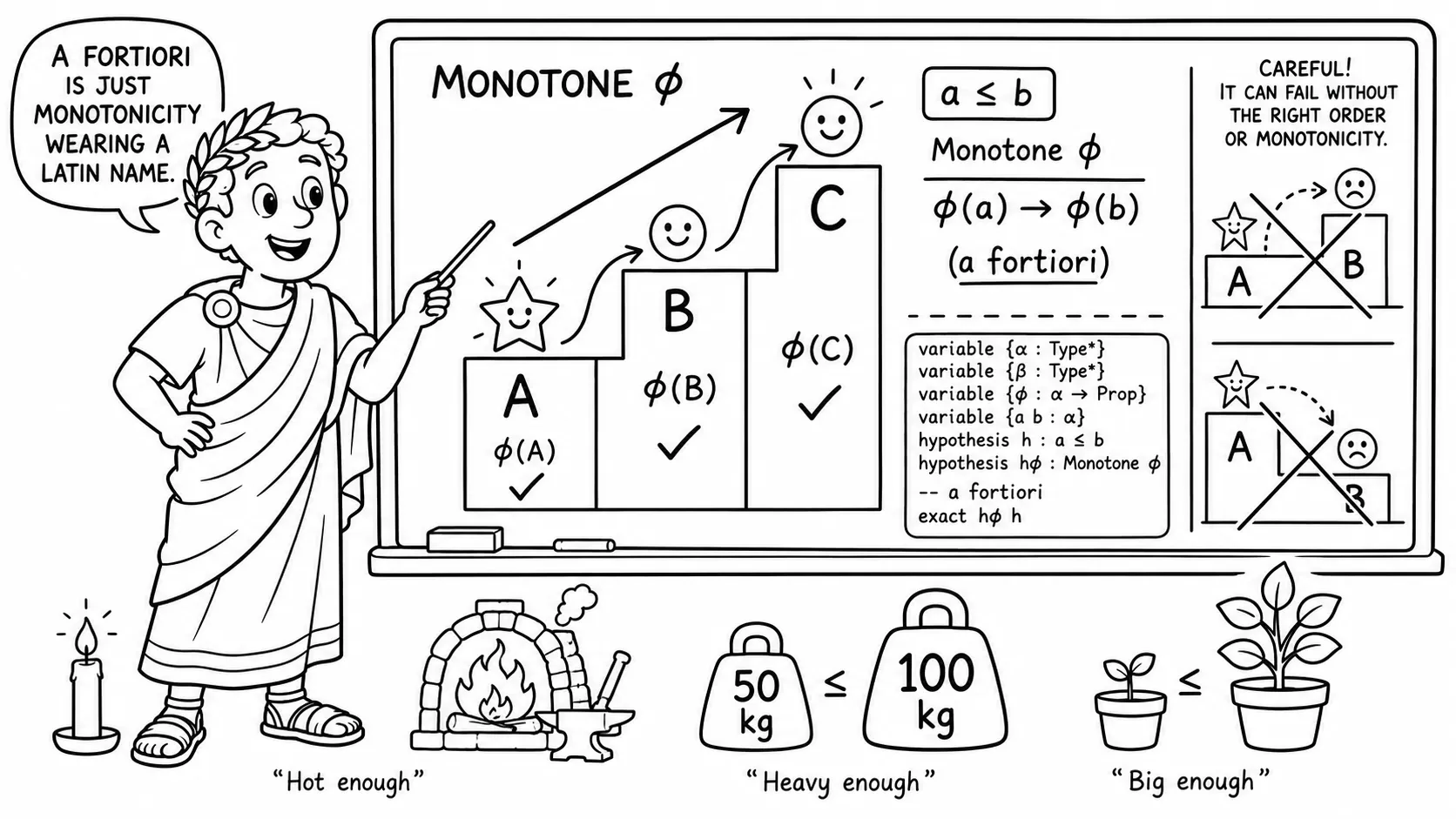
Table of contents
Open Table of contents
What the phrase actually says
A fortiori is Latin — literally “from the stronger,” elliptical for a fortiori ratione, “by the stronger reason.” An a-fortiori argument says: the conclusion already holds in some case, and the case you actually care about is more of whatever made it hold, so it holds all the more. English glosses it as “even more so” or “how much more.”
The structure has a fixed shape: an ordering of cases by “strength” along some dimension, plus a claim that the property in question tracks that ordering. There are two canonical directions.
- A maiori ad minus (greater → lesser): if the stronger case has the property, the weaker does too. “He carried 100 kg up the stairs, so a fortiori he can carry 50.” Capacity is monotone, so meeting the harder demand entails meeting the easier one.
- A minori ad maius (lesser → greater): if even the weak case has the property, the strong case does all the more. “If lighting a single candle is forbidden, a fortiori running a forge is.”
The formalization: monotonicity
The cleanest formalization — and the one that makes “was wrong” precise — is monotonicity. Take a poset of cases and a predicate . The upward a-fortiori step is exactly the assertion that is monotone (an up-set):
The downward version asserts is down-closed:
In Lean terms the inference step is an application of Monotone φ — that is, a ≤ b → φ a → φ b. Once you see it written this way, the rhetorical move stops being a rhetorical move: it’s the elimination rule for an order-preserving predicate.
So what does “my a-fortiori reasoning was wrong” mean?
It means: I argued that since case is a stronger instance than , and the conclusion held for , it must hold even harder for — and that inference doesn’t go through. Concretely, one of three assumptions failed.
- The predicate isn’t monotone. isn’t actually an up-set along this order — there’s a threshold, saturation, a U-shape, or a trade-off, so “more” stops implying “more.” This is the most common failure. “More fertilizer grew a bigger plant, so a fortiori twice as much grows a bigger one” — false past the toxicity threshold.
- Wrong order. isn’t really on the axis that governs ; you ranked them by the wrong dimension. This is often an equivocation on what “greater” means.
- Over-reach in the conclusion. You inferred more than the premise licenses. The rabbinic tradition names this guardrail explicitly: the dayyo (“it is sufficient”) principle in qal vaḥomer, that the inferred case can’t come out stronger than its source.
Almost every botched a-fortiori argument I’ve traced collapses into case 1: the order is fine, but the predicate just isn’t monotone along it, and “all the more” was doing the work of an assumption I never checked.
Where the move comes from
The reasoning is ancient and well-attested. Aristotle catalogues it as a topos “from the more and the less” (ek tou mallon kai hēttōn) in Rhetoric II.23 (~1397b). In the Talmudic tradition it’s qal vaḥomer (קל וחומר, “light and heavy”) — the first of Hillel’s seven middot and among R. Ishmael’s thirteen, with its constraints worked out in Bava Kamma 25a. There’s also a modern book-length formal treatment (Avi Sion, A Fortiori Logic, 2013), though I haven’t verified its arguments closely enough to vouch for them.
One honesty note
The monotonicity reading is the standard logical reconstruction, and I’d stand behind it — but it’s my framing of the structure, not a citation. The historical sources describe the move rhetorically, not as a theorem about order-preserving maps. What the formalization buys you isn’t authority; it’s a checklist. Next time you reach for “a fortiori,” you know exactly which three things to check before the conclusion is allowed to hold all the more.